
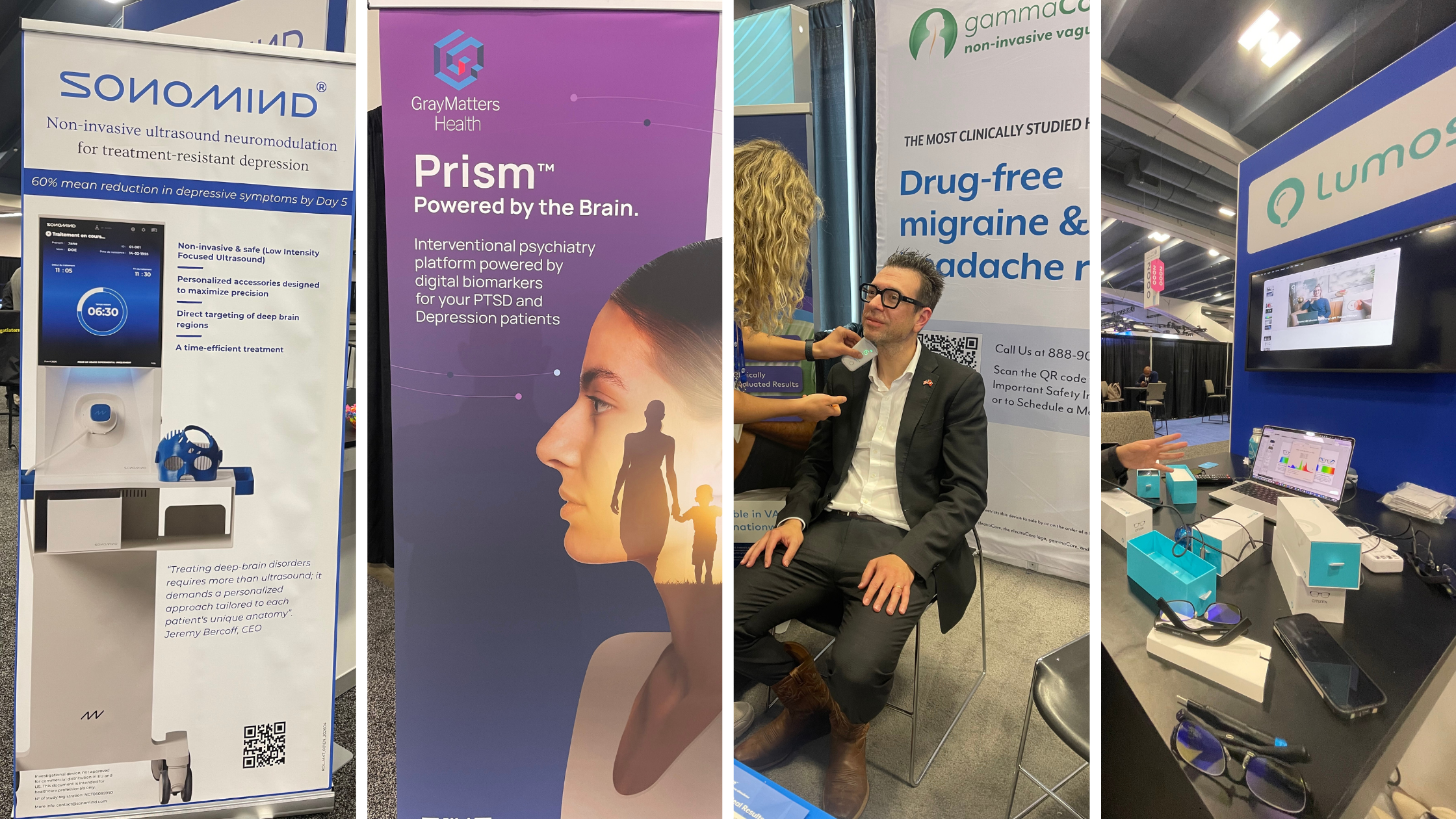
At this year’s American Psychiatric Association Annual Meeting 2026, one thing became increasingly clear: interventional psychiatry is expanding far beyond traditional medication management. Walking the exhibit hall and speaking with clinicians, researchers, and device companies, there was a noticeable shift toward technologies designed to make psychiatry more measurable, personalized, wearable, and biologically targeted.
While TMS and ketamine remained major themes throughout the conference, several newer technologies stood out for pushing the field in directions that would have sounded futuristic just a few years ago. Some are already FDA-cleared. Others are still early-stage. But collectively, they point toward where mental health treatment may be heading next.
Here are five technologies that stood out most to us at APA 2026.
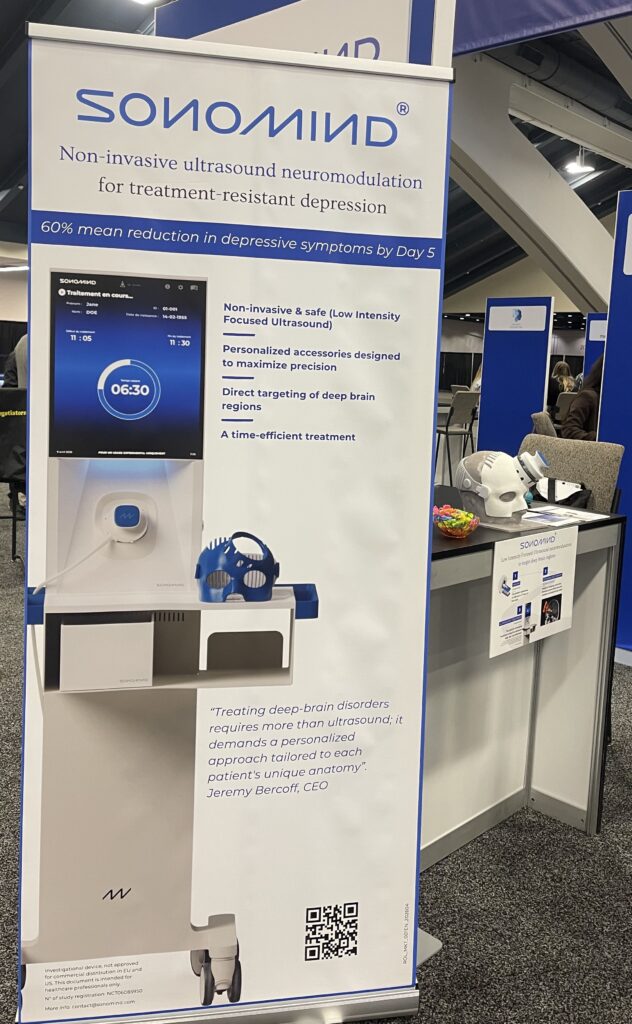
1. SonoMind — Focused Ultrasound for Psychiatry
Perhaps the most ambitious technology we encountered was from SonoMind, which is exploring focused ultrasound as a potential psychiatric intervention.
Unlike TMS, which stimulates cortical regions near the surface of the brain using magnetic fields, focused ultrasound has the potential to reach much deeper brain structures with far greater precision. That immediately raises interest in psychiatry, where disorders like depression, OCD, PTSD, and addiction are increasingly understood as circuit-based disorders involving deeper limbic and subcortical networks.
Focused ultrasound is already being explored in neurology for movement disorders, but psychiatric applications remain early. That matters. There is still a major gap between promising neuroscience and clinically validated psychiatric outcomes.
Still, what stood out at APA was not hype, but the broader direction: psychiatry is becoming increasingly interested in precision neuromodulation technologies capable of targeting specific neural circuits rather than broadly altering brain chemistry.
If focused ultrasound ultimately proves effective and scalable in psychiatry, it could represent one of the largest technological shifts since the introduction of TMS.
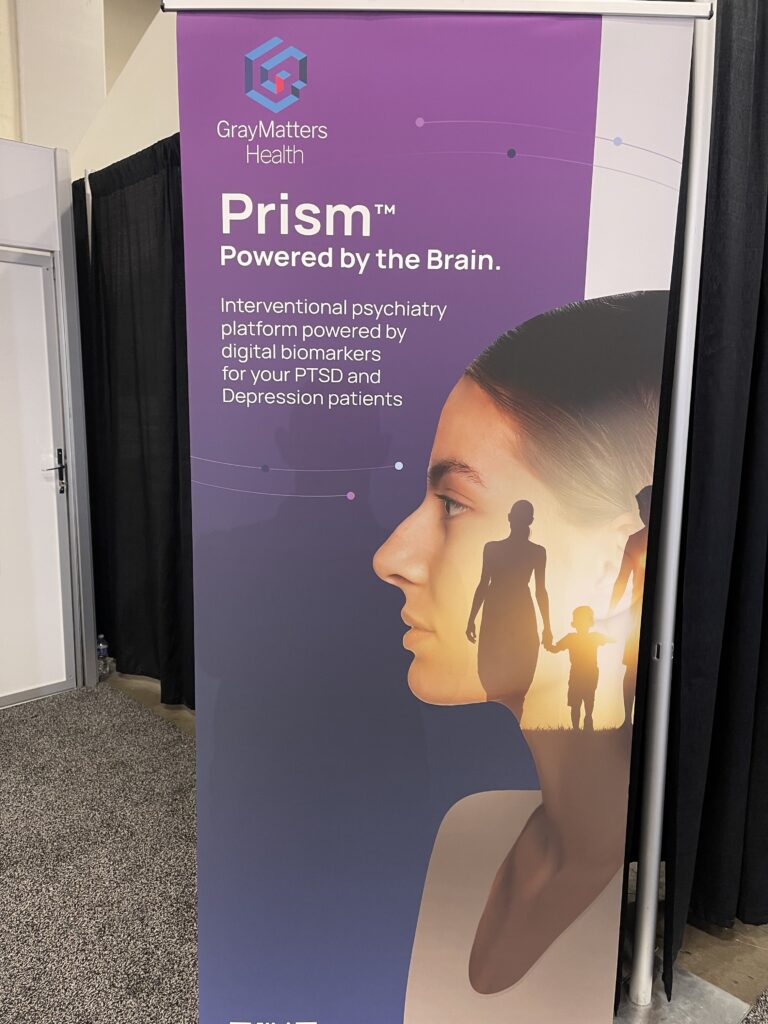
2. GrayMatters Health PRISM for PTSD — EEG-Guided Self-Neuromodulation
One of the more unique technologies on display came from GrayMatters Health and their FDA-cleared PRISM system for PTSD.
PRISM combines EEG measurements with what the company describes as fMRI-informed biomarkers associated with PTSD symptom networks. During treatment, patients engage with a computer simulation while learning internal mental strategies designed to regulate relevant brain activity.
What makes this particularly interesting is that it does not fit neatly into traditional categories like psychotherapy, neurofeedback, or neuromodulation. It sits somewhere between them.
The company also introduced “Prism Imagine,” a new generative AI-powered tool intended to help patients visualize and reinforce the mental strategies they develop during treatment.
There are still important questions here. Biomarker-driven psychiatry remains a developing field, and the history of psychiatric biomarkers is full of overpromising. But PRISM reflects a broader trend emerging across APA this year: psychiatry is moving toward objective brain-based measurements and personalized regulation strategies rather than symptom checklists alone.
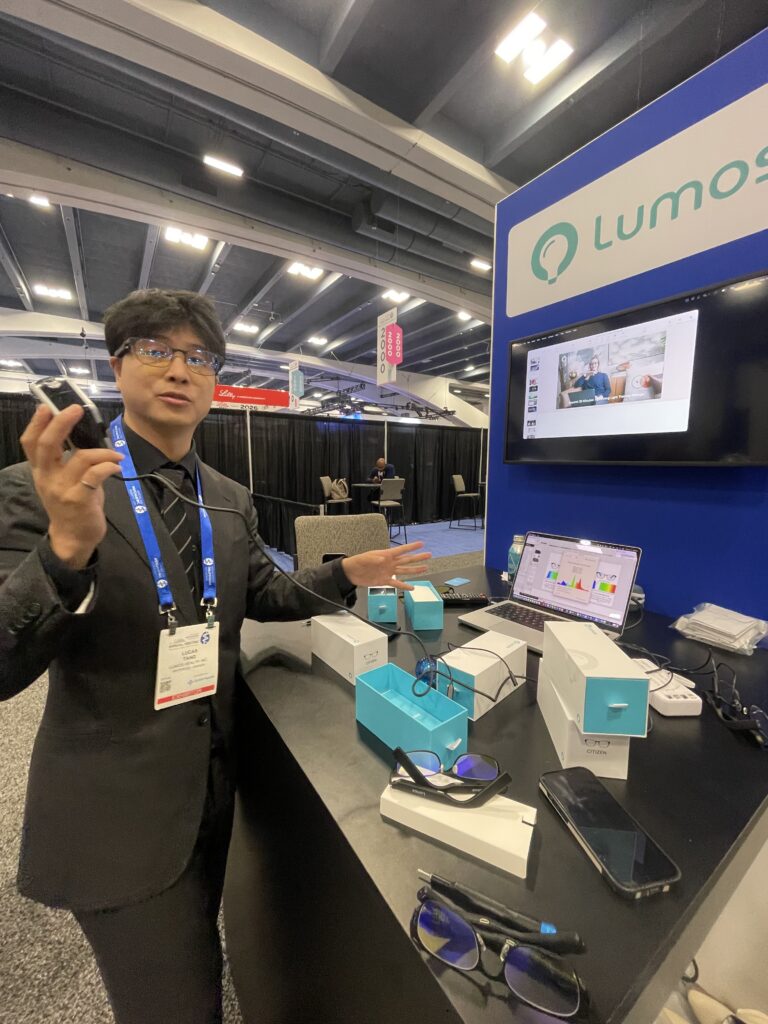
3. Lumos Glasses — Digital Therapeutics Through Light
Another company generating attention at APA was Lumos Glasses, which is developing wearable light-based technologies aimed at influencing mood, circadian rhythms, and mental wellness.
The overlap between light exposure, circadian biology, and psychiatric illness has become increasingly difficult to ignore in recent years. Sleep disruption, light exposure patterns, seasonal changes, and circadian dysregulation are now understood to play significant roles across depression, bipolar disorder, PTSD, and anxiety disorders.
What makes Lumos interesting is the move toward portability and integration into daily life. Rather than requiring a patient to sit in front of a dedicated light box each morning, wearable systems attempt to embed circadian interventions into everyday routines.
This fits a larger movement we saw repeatedly at APA 2026: psychiatry increasingly moving outside the clinic walls.
The challenge, however, will be separating meaningful therapeutic effects from the growing wave of consumer wellness technology. Light therapy itself has legitimate evidence behind it, particularly for seasonal depression and circadian disorders. But wearable psychiatric devices still need rigorous clinical validation to avoid becoming another overcrowded wellness category.

4. gammaCore — Vagus Nerve Stimulation Without Surgery
gammaCore drew significant attention for its non-invasive vagus nerve stimulation (nVNS) platform.
Traditional vagus nerve stimulation has existed in psychiatry and neurology for years, but implantation surgery has limited widespread adoption. gammaCore instead delivers stimulation externally through the neck, avoiding surgical implantation entirely.
The company’s primary indications have focused on headache disorders and pain, but interest in vagus nerve modulation within psychiatry continues to grow because of the vagus nerve’s role in autonomic regulation, inflammation, stress response, and emotional regulation.
This is another example of a larger trend at APA 2026: increasing interest in the nervous system itself, not just neurotransmitters.
The autonomic nervous system, inflammation, heart rate variability, stress physiology, and brain-body interactions are becoming central topics in modern psychiatric research. Technologies like gammaCore sit directly inside that shift.
That said, psychiatric applications of non-invasive vagus nerve stimulation still need stronger evidence before broad conclusions can be made. The excitement is real, but the clinical data remains mixed depending on indication and protocol.
5. Psychiatry Is Becoming More Technological, Measurable, and Personalized
The biggest takeaway from APA 2026 was not any single device.
It was the realization that psychiatry is rapidly evolving into a field increasingly shaped by engineering, neurotechnology, biomarkers, wearables, AI, and circuit-based neuroscience.
Ten years ago, most psychiatric conversations centered around medications and therapy models. At APA 2026, conversations increasingly revolved around neural circuits, EEG biomarkers, personalized stimulation, wearable interventions, autonomic regulation, and digital therapeutics.
That does not mean all of these technologies will succeed. Many will not.
Psychiatry has a long history of enthusiasm outrunning evidence. Some of these tools may ultimately prove clinically transformative. Others may fade once larger real-world studies emerge.
But the direction of the field now feels unmistakable: psychiatry is becoming increasingly interventional, measurable, and technology-driven.
And APA 2026 made that impossible to ignore.
