
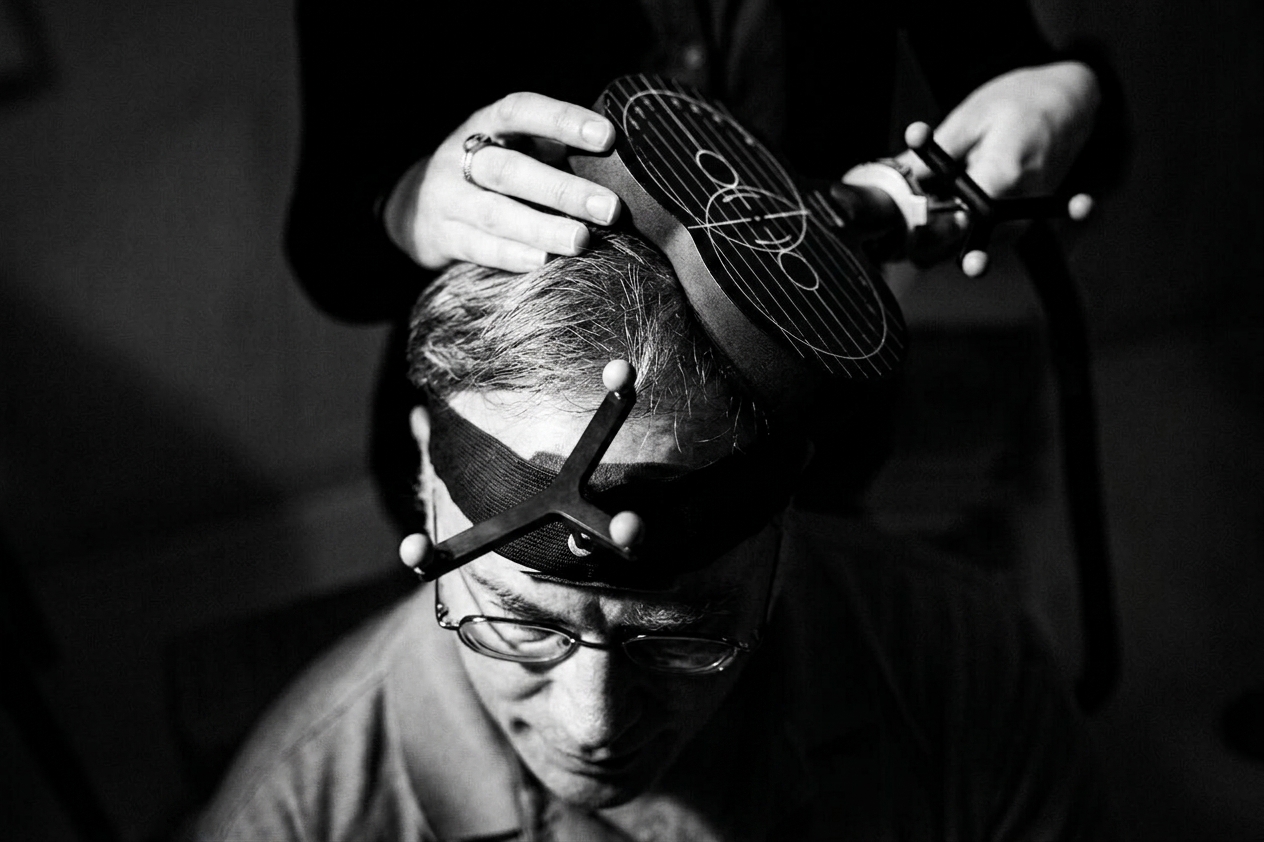
Dual-site tACS for social anxiety may offer a new way to target the brain circuitry involved in controlling avoidance. A preregistered study published in The Journal of Neuroscience found that precisely timed electrical stimulation strengthened communication between frontal and sensorimotor regions while improving performance on an emotional action task.
The findings do not establish tACS as a treatment for social anxiety disorder. Instead, they provide an early demonstration that researchers may be able to influence a specific neural process associated with maladaptive avoidance.
Why Persistent Avoidance Is Difficult To Treat
Avoidance can provide immediate relief from anxiety, but repeated avoidance also prevents people from learning that feared situations may be manageable or safe. This cycle can help sustain social anxiety over time.
Psychotherapy, particularly exposure-based treatment, aims to interrupt that pattern. Yet successful exposure requires a person to override automatic avoidance and engage with situations that feel threatening. Researchers are therefore investigating whether neuromodulation could strengthen the cognitive control processes needed to support that effort.
Unlike transcranial magnetic stimulation, transcranial alternating current stimulation, or tACS, delivers weak oscillating electrical currents through electrodes placed on the scalp. The goal is not simply to activate one brain region. It is to influence the timing of rhythmic activity across connected regions.
How Dual-Site tACS For Social Anxiety Targets Brain Rhythms
The new study focused on communication between the dorsolateral prefrontal cortex, or dlPFC, and the sensorimotor cortex. The dlPFC supports goal-directed control, while the sensorimotor cortex helps translate those goals into actions.
Researchers applied 6-hertz theta stimulation over the lateral prefrontal cortex and 75-hertz gamma stimulation over the sensorimotor cortex. During in-phase stimulation, the gamma signal was timed to align with peaks in the theta rhythm. Anti-phase stimulation used the same frequencies and intensity but shifted their timing.
This distinction allowed the investigators to test whether coordination between the regions, rather than general electrical stimulation, influenced behavior.
A Preregistered Test In Highly Socially Anxious Participants
The final sample included 49 adults selected for high self-reported social anxiety. Participants were not necessarily diagnosed with social anxiety disorder, an important distinction when interpreting the clinical relevance.
During concurrent tACS and functional MRI, participants completed an approach-avoidance task using a joystick. Some trials followed intuitive social responses, such as approaching a happy face. Other trials required participants to override those tendencies, such as pushing away a happy face or pulling an angry face closer.
Each participant experienced in-phase, anti-phase, and sham stimulation conditions. This within-participant design helped researchers compare how stimulation timing affected behavior and brain activity while limiting the influence of individual baseline differences.
Synchronized Stimulation Improved Task Performance
In-phase stimulation strengthened functional coupling between the dlPFC and sensorimotor cortex during the emotional control challenge. The same effect was not observed between the dlPFC and a visual region that was not targeted, supporting the anatomical specificity of the result.
Across task conditions, in-phase stimulation reduced the odds of an incorrect response by 22 percent compared with sham stimulation. Anti-phase stimulation did not produce a statistically significant improvement.
The more specific improvement in overriding automatic emotional actions depended on target engagement. Participants whose dlPFC showed a stronger physiological response to stimulation experienced greater benefits from in-phase stimulation relative to anti-phase stimulation.
The Amygdala May Face Stronger Cortical Competition
The results suggest that in-phase tACS did not improve control by increasing direct communication between the dlPFC and amygdala. Instead, strengthened dlPFC-sensorimotor coupling may have allowed goal-directed action signals to compete more effectively with emotionally driven tendencies.
In practical terms, the stimulation may have helped the brain translate an intentional rule into action despite conflicting emotional information. This proposed mechanism remains an interpretation, however, because the study measured blood-oxygen-level-dependent activity rather than electrical oscillations directly.
What Makes This Study Distinct
The study extends earlier research in nonanxious participants into a population with elevated social anxiety. It also indicates that anxiety may alter which prefrontal territory supports emotional action control. Greater trait anxiety was associated with stronger stimulation-related engagement in the dlPFC, although anxiety scores alone did not predict behavioral improvement.
That difference reinforces the value of measuring neural target engagement instead of assuming that an identical stimulation protocol affects everyone in the same way.
A Potential Tool For Future Anxiety Treatment Research
Future studies will need to determine whether repeated, individually optimized stimulation can improve real-world avoidance or clinical symptoms. The present experiment measured immediate task performance, not treatment response, daily functioning, or lasting change.
If the mechanism is replicated, dual-site tACS could eventually be studied as an adjunct to therapies that require patients to approach feared situations. For now, the work offers a controlled proof of concept: synchronizing relevant brain circuits may help strengthen emotional action control, but clinical benefit has yet to be demonstrated.
Citations
Meijer S, Bramson B, Toni I, Roelofs K. “Improving Emotion Control in Social Anxiety by Targeting Rhythmic Brain Circuits.” The Journal of Neuroscience. 2026. https://doi.org/10.1523/JNEUROSCI.0769-25.2026
Bramson B, den Ouden HEM, Toni I, Roelofs K. “Improving Emotional-Action Control by Targeting Long-Range Phase-Amplitude Neuronal Coupling.” eLife. 2020. https://doi.org/10.7554/eLife.59600
Explore more at https://www.interventionalpsychiatry.org/
