

More consistent targeting of depression-related brain networks may begin with a change in TMS coil placement. A new study in Brain Stimulation introduces the F5-AF7 method, a scalp-based approach designed to direct stimulation more selectively toward the frontoparietal network.
The method combines a familiar clinical tool, scalp measurement, with insights from functional brain mapping. Its promise is practical: network-informed targeting without requiring an individual MRI scan or neuronavigation system. Whether that precision improves depression outcomes remains untested.
Why Conventional Placement Can Reach Different Networks
Repetitive transcranial magnetic stimulation of the left dorsolateral prefrontal cortex is an established treatment for major depressive disorder. However, treatment response varies, and coil placement influences which brain networks receive stimulation.
The widely used Beam F3 approach locates a prefrontal target through scalp measurements. It was not developed around functional network boundaries, which differ across individuals. Consequently, the same placement rule can stimulate different combinations of neighboring networks.
How The F5-AF7 Method Refines The Target
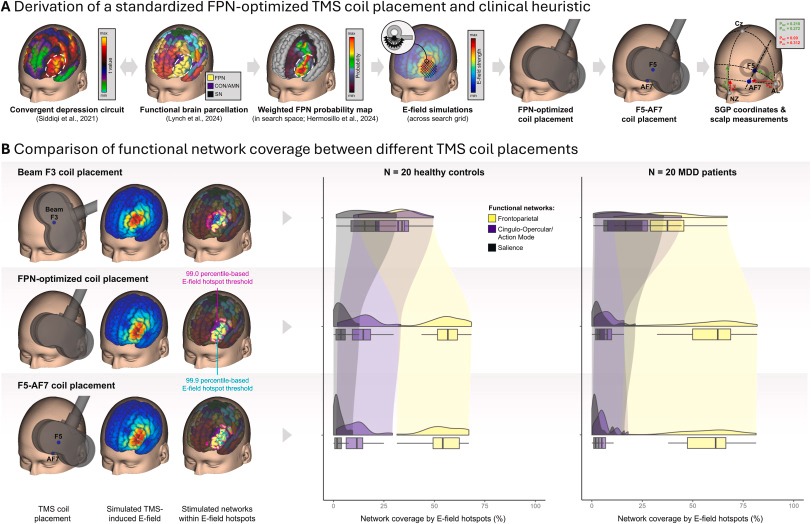
Researchers first identified a left prefrontal target within a population-based map of the frontoparietal network. They then simulated the electric fields produced by a figure-of-eight coil across different positions and orientations on a standard head model.
The placement maximizing overlap with the target sat near F5, a location in the EEG electrode system. Its handle aligned along the axis connecting F5 and AF7, approximately parallel to the head’s front-to-back midline.
This produced a reproducible measurement rule that places the coil farther forward and laterally than conventional Beam F3 targeting.
Testing The Rule Against Individual Brain Maps
The team evaluated the optimized placement and its simplified F5-AF7 approximation against Beam F3 using precision functional network maps from 20 healthy participants and 20 people with major depressive disorder.
These comparisons assessed how simulated electric-field hotspots overlapped each person’s networks. They did not test antidepressant treatment or measure symptom improvement.
Including individual brain maps mattered because an approach developed from population averages must still perform across differences in network anatomy.
Stronger Overlap With The Intended Network
Both new placements produced significantly greater frontoparietal network coverage than Beam F3. For the simplified F5-AF7 approach, standardized differences were large in healthy participants and patients, with effect sizes of 2.62 and 1.25, respectively.
The simulations also showed less coverage of neighboring salience and cingulo-opercular/action-mode networks. Findings were reproduced using an independent network parcellation, strengthening confidence that they were not tied to one mapping framework.
These effect sizes describe targeting differences, not treatment effectiveness.
Why Coil Direction Matters
TMS induces an electric field in the cortex. Changing coil position or orientation changes where that field concentrates and how it overlaps functional networks.
The F5-AF7 approach remained largely robust to simulated tilts of up to 10 degrees. Rotating the handle away from the intended axis, however, progressively reduced frontoparietal coverage and increased neighboring-network involvement.
The findings therefore emphasize orientation as an essential part of targeting, alongside the scalp location itself.
Precision Still Needs A Clinical Test
The frontoparietal network overlaps a depression circuit identified through converging lesion and stimulation research. That makes it a plausible target, but greater selectivity is not automatically better treatment.
Other networks may contribute to antidepressant effects or respond to different symptom profiles. A peer-reviewed review likewise concludes that circuit-based targeting requires rigorous prospective trials to establish clinical value.
The more forward and lateral placement may also increase discomfort through stimulation of nearby nerves and muscles. Tolerability and dosing therefore require direct evaluation.
A Practical Route To Comparative Trials
The study’s distinguishing contribution is a network-derived placement rule specifying both coil location and orientation without requiring individualized imaging during implementation.
That could make comparative trials more accessible across clinics. The next step is to test F5-AF7 against established approaches, measuring depression outcomes, tolerability, and consistency. For now, it offers a testable targeting strategy rather than demonstrated clinical superiority.
Citations
- Lueckel M, et al. (2026). A Standard Coil Placement For Reliable Transcranial Magnetic Stimulation Of The Frontoparietal Depression Network: The ‘F5-AF7 Method’. Brain Stimulation. PIIS1935861X26002056.pdf
- Cash RFH, Zalesky A. (2024). Personalized And Circuit-Based Transcranial Magnetic Stimulation: Evidence, Controversies, And Opportunities. Biological Psychiatry.
Explore more at https://www.interventionalpsychiatry.org/
