
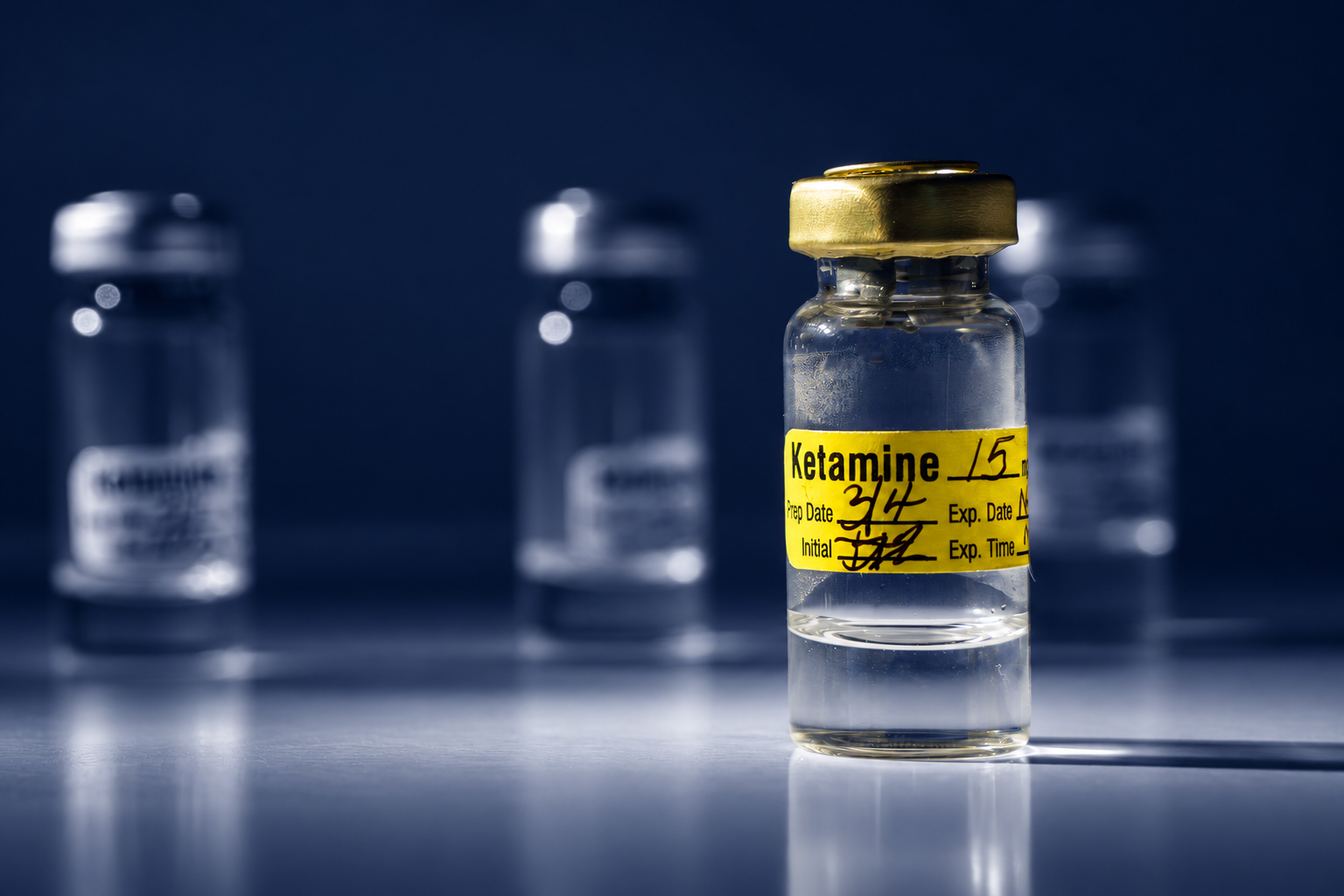
Making rapid relief last remains a central challenge in ketamine treatment. A systematic review and meta-analysis examines whether adding medications or structured psychological interventions can extend ketamine’s benefits in adults with treatment-resistant depression.
Its conclusion is measured: across seven randomized trials involving 346 participants, augmentation did not produce a statistically significant overall advantage. Behavioral approaches offered preliminary signals, but the evidence does not establish a reliable add-on treatment.
Rapid Relief Leaves A Maintenance Challenge
Treatment-resistant depression generally describes depression that has not responded adequately to at least two antidepressant trials of sufficient dose and duration. For these patients, intravenous ketamine offers a different treatment approach, with antidepressant effects that can emerge rapidly.
However, improvement after an infusion may fade, creating a need for continued treatment planning. Researchers have therefore explored whether another intervention could help preserve the initial response or improve tolerability.
The practical question is whether adding treatment produces better outcomes than ketamine with a comparison intervention.
Seven Trials Tested Different Add-On Strategies
The review searched MEDLINE, Embase, and PsycINFO through October 29, 2025. Eligible randomized trials compared intravenous ketamine plus augmentation against ketamine plus placebo, sham treatment, or an active control.
Pharmacological strategies included glutathione, riluzole, lamotrigine, lithium, and D-cycloserine. Behavioral strategies involved cognitive behavioral therapy, or CBT, and automated self-association training, or ASAT.
Randomization matters because symptom improvement after combination treatment does not, by itself, demonstrate that the added component helped. A comparison group helps distinguish augmentation effects from ketamine’s effects and other influences.
Ketamine’s Benefits Did Not Consistently Increase
Across the included trials, ketamine treatment was associated with antidepressant improvement. The additional interventions generally did not outperform their respective controls, and pharmacological augmentation showed no additional benefit at primary endpoints.
An exploratory random-effects meta-analysis found a standardized mean difference of −0.12, with a 95% confidence interval from −0.37 to 0.12 and a p value of 0.323.
In practical terms, the pooled estimate was small and statistically inconclusive. The confidence interval crossed zero, meaning the analysis could not establish an overall advantage for augmentation.
Reported statistical heterogeneity was zero, but the comparisons still differed clinically in their interventions and designs. That statistic does not make the strategies interchangeable or resolve the uncertainty created by limited evidence.
Behavioral Approaches Offer An Early Signal
CBT and ASAT produced preliminary indications of better maintenance of antidepressant effects. However, each approach was evaluated in only one trial, leaving uncertainty about whether the findings would replicate.
In the ASAT randomized trial, participants completed brief computerized exercises designed to strengthen positive associations with themselves. Training began the day after an infusion and continued twice daily for four days.
Depression scores remained relatively low over the 30-day study period in the ketamine-plus-active-training group, while symptoms increased after ketamine plus sham training. This encouraging pattern requires confirmation before ASAT can be considered an established maintenance strategy.
A Learning Window Remains A Hypothesis
The rationale for behavioral augmentation involves neuroplasticity, the brain’s capacity to change its connections and responses. Ketamine is hypothesized to create a period of increased plasticity during which structured learning could help reinforce more adaptive patterns.
CBT and ASAT approach that possibility differently. CBT addresses patterns of thinking and behavior, while ASAT uses repeated computerized pairings to target self-associations.
This framework offers a testable explanation for potential durability. It does not demonstrate that a specific biological mechanism caused the clinical findings.
Durability Needs Stronger Evidence
The review brings medication and behavioral augmentation into one assessment of randomized evidence. Its findings do not support routine augmentation of intravenous ketamine specifically to extend antidepressant effects.
No clear new safety signal emerged, although inconsistent adverse-event reporting limits reassurance about individual combinations.
Larger trials need to establish which patients might benefit, when an intervention should begin, and whether improvements persist beyond short follow-up periods. For now, extending ketamine’s benefits remains a promising research objective, with preliminary behavioral findings but no consistently supported add-on strategy.
Citations
- Augmentation Strategies For Intravenous Ketamine In Treatment-Resistant Depression: A Systematic Review And Meta-Analysis. Journal of Affective Disorders.
- Price RB, et al. A Novel, Brief, Fully Automated Intervention To Extend The Antidepressant Effect Of A Single Ketamine Infusion: A Randomized Clinical Trial. American Journal of Psychiatry. 2022;179:959–968.
Explore more at https://www.interventionalpsychiatry.org/
