
For years, clinicians have refined transcranial magnetic stimulation (TMS) by adjusting treatment schedules, stimulation patterns, and total dose. Now, a new randomized clinical trial suggests another factor may be just as important: choosing the right location in the brain for each individual patient. This emerging evidence could help shape the next generation of accelerated TMS for depression, bringing psychiatry closer to the precision medicine approaches already common in other areas of healthcare.
Why Traditional TMS Targeting Has Limitations
TMS has been an FDA-cleared treatment for major depressive disorder since 2008 and has become an important option for people whose depression has not responded to medication. Most current treatments rely on standardized scalp measurements to determine where stimulation is delivered.
While this approach has helped many patients, it assumes that the same surface measurements correspond to the same underlying brain circuits in every individual. Brain anatomy and functional connectivity vary from person to person, meaning the ideal stimulation site may differ considerably between patients.
Researchers have increasingly questioned whether individualized targeting could improve treatment outcomes without changing the stimulation itself.
Accelerated TMS For Depression Benefits From Personalized Brain Mapping
The newly published Accelerated Intelligent Neuromodulation Therapy (AINT) trial was designed to answer that question directly. Rather than comparing different stimulation protocols, investigators kept every treatment parameter identical except for one variable: how the treatment target was selected.
Forty adults with treatment-resistant depression underwent resting-state functional MRI before treatment. Half received accelerated TMS guided by individualized functional connectivity maps, while the other half received treatment using the conventional Beam F3 scalp targeting method. Both groups received the same high-dose accelerated protocol consisting of ten intermittent theta burst stimulation sessions per day over five consecutive days.
This study design allowed researchers to isolate the value of personalized targeting while eliminating many of the confounding factors that complicated earlier studies.
More Precise Targeting Produced Stronger Clinical Outcomes
One month after treatment, patients who received connectivity-based targeting experienced significantly greater improvements in depression symptoms.
The individualized targeting group demonstrated:
- An 80% response rate compared with 60% in the scalp-based group
- A 65% remission rate compared with 50% using conventional targeting
- A large treatment effect size of 0.8
- A number needed to scan of five patients to produce one additional treatment response
Importantly, both groups received identical stimulation intensity, treatment duration, neuronavigation, and clinical monitoring. The primary difference was selecting a more personalized treatment location based on each participant’s brain connectivity profile.
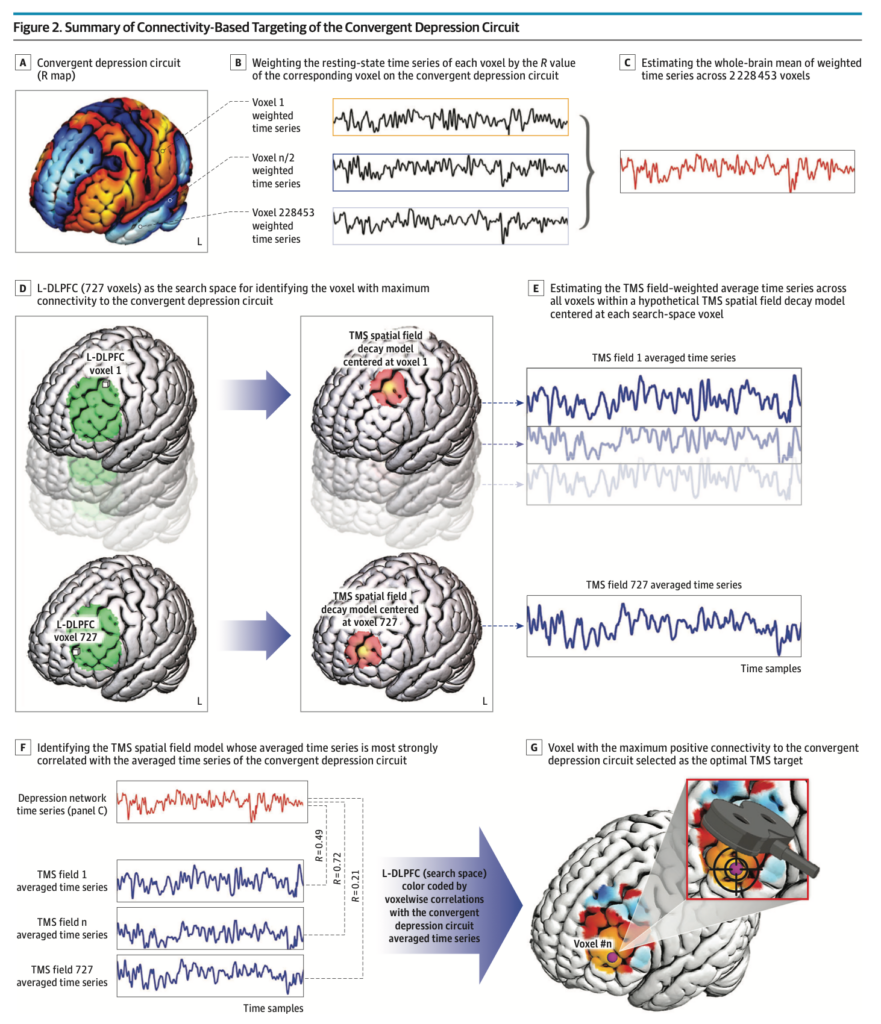
Illustration: JAMA Psychiatry Published online June 24,2026
Looking Beyond Anatomy To Brain Networks
Traditional targeting methods focus primarily on external landmarks. Connectivity-based targeting instead identifies regions within the left dorsolateral prefrontal cortex that show the strongest functional relationship with a broader depression-related brain network.
Researchers specifically targeted areas most strongly connected to what has been described as a convergent depression circuit, which includes communication patterns involving the subgenual cingulate cortex and several other brain regions implicated in mood regulation.
Rather than assuming every brain is organized identically, this approach recognizes that functional brain networks are individualized. The goal is not simply to stimulate the same anatomical location in every patient but to engage the most therapeutically relevant circuit for each individual.
What Makes This Trial Stand Out
Several accelerated TMS protocols have shown impressive clinical outcomes over the past few years, including Stanford Accelerated Intelligent Neuromodulation Therapy (SAINT). However, those studies combined several innovations simultaneously, including accelerated dosing, higher pulse counts, neuronavigation, and individualized imaging.
Until now, it remained unclear which elements contributed most to the improved outcomes.
The AINT trial addressed that uncertainty by changing only the targeting method while keeping every other treatment component constant. This head-to-head comparison provides some of the strongest evidence to date that personalized connectivity-based targeting contributes meaningfully to treatment success.
Researchers also demonstrated that individualized targets were reproducible within the same individual while remaining distinct between different participants, supporting the reliability of this imaging approach.
What This Means For The Future Of TMS
Although this was a relatively small, single-center study involving 40 participants, the findings point toward an important shift in interventional psychiatry. Rather than relying solely on standardized treatment locations, future TMS protocols may increasingly incorporate individualized brain mapping to optimize outcomes.
Larger multicenter trials will be needed to confirm these findings and evaluate long-term effectiveness. Researchers will also continue exploring whether less expensive biomarkers, including EEG and other physiological measures, might eventually provide similar personalization without requiring functional MRI.
For now, the study offers compelling evidence that precision targeting may represent one of the next major advances in accelerated TMS for depression, helping clinicians better match treatment to each patient’s unique brain network rather than relying on one-size-fits-all positioning.
Citations
- Taylor JJ, Kare MR, Haj-Darwish D, et al. Connectivity- vs Scalp-Based Targeting of Accelerated Transcranial Magnetic Stimulation for Depression: A Randomized Clinical Trial. JAMA Psychiatry. 2026. https://jamanetwork.com/journals/jamapsychiatry/fullarticle/10.1001/jamapsychiatry.2026.1100
- Cash RFH, Zalesky A. Personalized Targeting for Transcranial Magnetic Stimulation in Depression. Nature Reviews Neurology. 2023. https://www.nature.com/articles/s41582-023-00818-2
Explore more at https://www.interventionalpsychiatry.org/
