
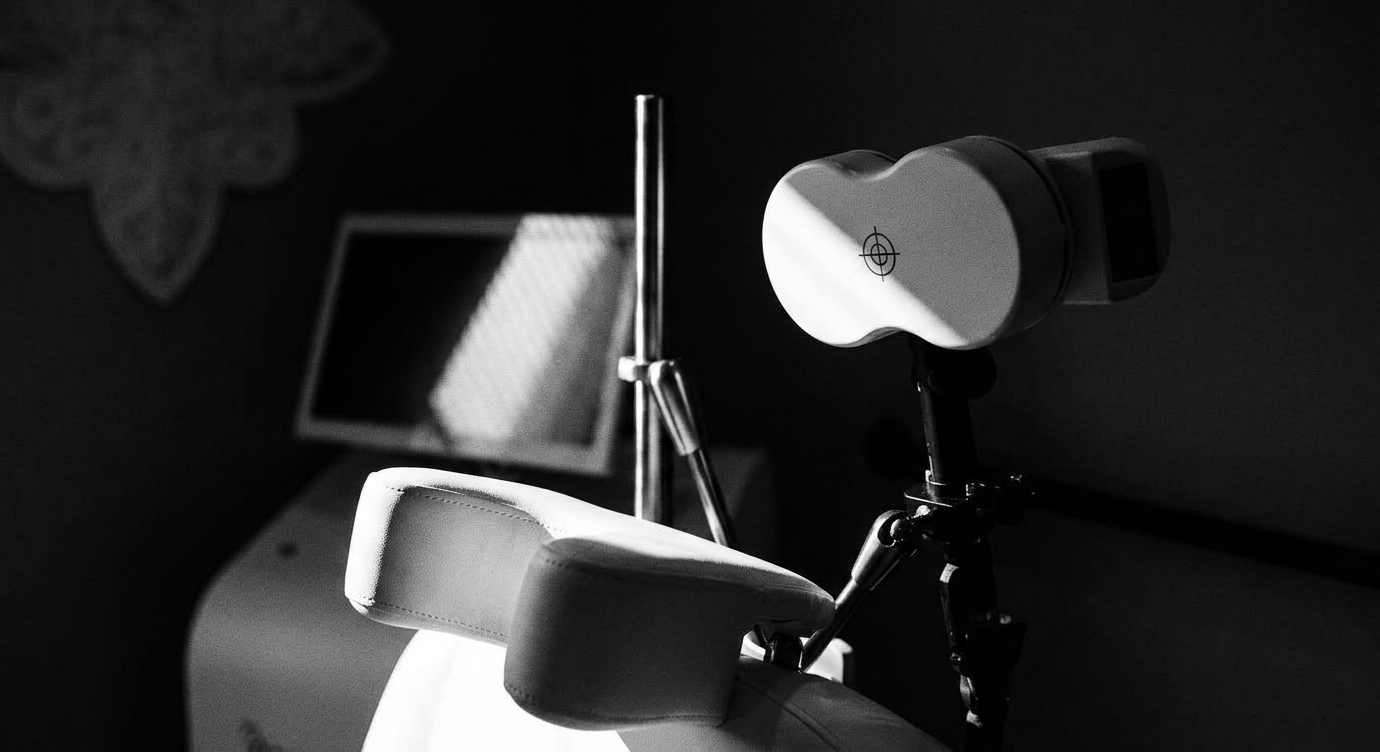
Personalized TMS for neuropathic pain could move noninvasive brain stimulation beyond fixed anatomical targets and toward treatment guided by each patient’s functional brain networks. A preliminary study now suggests that this approach is feasible, well tolerated, and associated with improvements across several dimensions of chronic pain.
Why Conventional Motor Cortex Targeting Has Limits
Neuropathic pain develops when disease or injury affects the somatosensory nervous system. The condition can include burning, electric, or shooting sensations, but its burden extends beyond pain intensity to mood, attention, sleep, mobility, and daily functioning.
Repetitive transcranial magnetic stimulation, or rTMS, has been studied as a noninvasive option for patients whose symptoms remain difficult to control. Treatment commonly targets the primary motor cortex, particularly the region associated with hand movement.
This strategy can reduce pain for some patients, but response rates remain inconsistent. A frequently used protocol involving 10 sessions over two weeks has produced response rates of approximately 40% in earlier studies. One possible limitation is that a standard anatomical location may not engage the same therapeutic circuitry in every patient.
Personalized TMS For Neuropathic Pain Uses Connectivity As A Guide
The new open-label study tested whether resting-state functional MRI could identify a more individualized stimulation site. Rather than selecting the same motor cortex coordinate for everyone, researchers searched each participant’s brain for an accessible location within the somato-cognitive action network, or SCAN, that showed strong connectivity with the cingulo-opercular network.
The SCAN is a recently characterized system interspersed with movement-specific regions of the motor cortex. It appears to help integrate movement, physiological regulation, action planning, and internal bodily signals.
The cingulo-opercular network includes regions involved in attention, cognitive control, emotion, and pain processing. Some of its central structures are too deep to stimulate precisely with a standard figure-of-eight TMS coil. The researchers therefore targeted a surface-accessible SCAN region that was functionally connected to this deeper network.
A Small Trial Designed Around Individual Brain Organization
Twenty adults with chronic neuropathic pain received 10 sessions of 10-Hz rTMS over two weeks. Each target was calculated from the participant’s MRI data and transferred into a neuronavigation system for treatment delivery.
The personalized targets were widely distributed. On average, they were more than 15 millimeters from the group-level center, with some separated by nearly 46 millimeters. This variation supports the study’s central premise: a single coordinate may miss the strongest network connection in many patients.
All participants completed treatment and immediate assessments. Eighteen completed the one-month follow-up. Most had postherpetic neuralgia, while smaller groups had diabetic peripheral neuropathy, trigeminal neuralgia, or traumatic neuropathy.
Half Of Participants Met The Response Threshold
Ten of the 20 participants achieved at least a 30% reduction in pain intensity immediately after treatment. The 50% response rate was maintained at one month.
Average pain intensity fell by approximately 27%, slightly below the predefined individual response threshold. Participants also showed improvements in neuropathic symptoms, pain interference, negative affect, and overall health measures.
No serious adverse effects were reported. Five participants experienced minor effects, including fatigue or dizziness.
The results varied across pain conditions, but each diagnostic subgroup was too small to support reliable comparisons. Although all three participants with diabetic peripheral neuropathy responded, that finding should be treated as exploratory rather than evidence of greater effectiveness in that population.
Connectivity Changes Tracked The Broader Burden Of Pain
Changes in SCAN and cingulo-opercular connectivity were associated with improvements in pain interference, anxiety, and depressive symptoms. They were not significantly associated with reductions in pain intensity itself.
This distinction may be important. The targeted network may influence how pain affects attention, emotion, and daily activity rather than directly regulating the strength of the sensory signal.
However, the group did not show a significant overall change in network connectivity. The imaging findings therefore represent an association between individual brain changes and symptom improvement, not proof that rTMS reorganized the network or caused the clinical effects.
A Precision Model That Still Requires Controlled Testing
This study differs from conventional pain-focused rTMS research because connectivity was used prospectively to select each treatment target. It offers a practical framework for translating individualized brain-network mapping into clinical stimulation.
Still, the trial was small, open-label, and lacked sham treatment or a conventional motor cortex comparison group. Medication regimens continued during treatment, and nonspecific effects cannot be separated from the effects of stimulation.
The next step is a larger randomized trial comparing personalized targeting with sham stimulation and standard motor cortex targeting. Until then, personalized TMS for neuropathic pain should be viewed as a promising precision-neuromodulation strategy, not an established improvement over current protocols.
Citations
Huang Z, et al. “Personalising Transcranial Magnetic Stimulation Therapy for Neuropathic Pain with Somato-Cognitive Action Network Connectivity to Cingulo-Opercular Network: A Preliminary Open-Label Study.” medRxiv, 2026. https://doi.org/10.64898/2026.08.23.26361115
Gordon EM, et al. “A Somato-Cognitive Action Network Alternates with Effector Regions in Motor Cortex.” Nature, 2023. https://doi.org/10.1038/s41586-023-05964-2
