
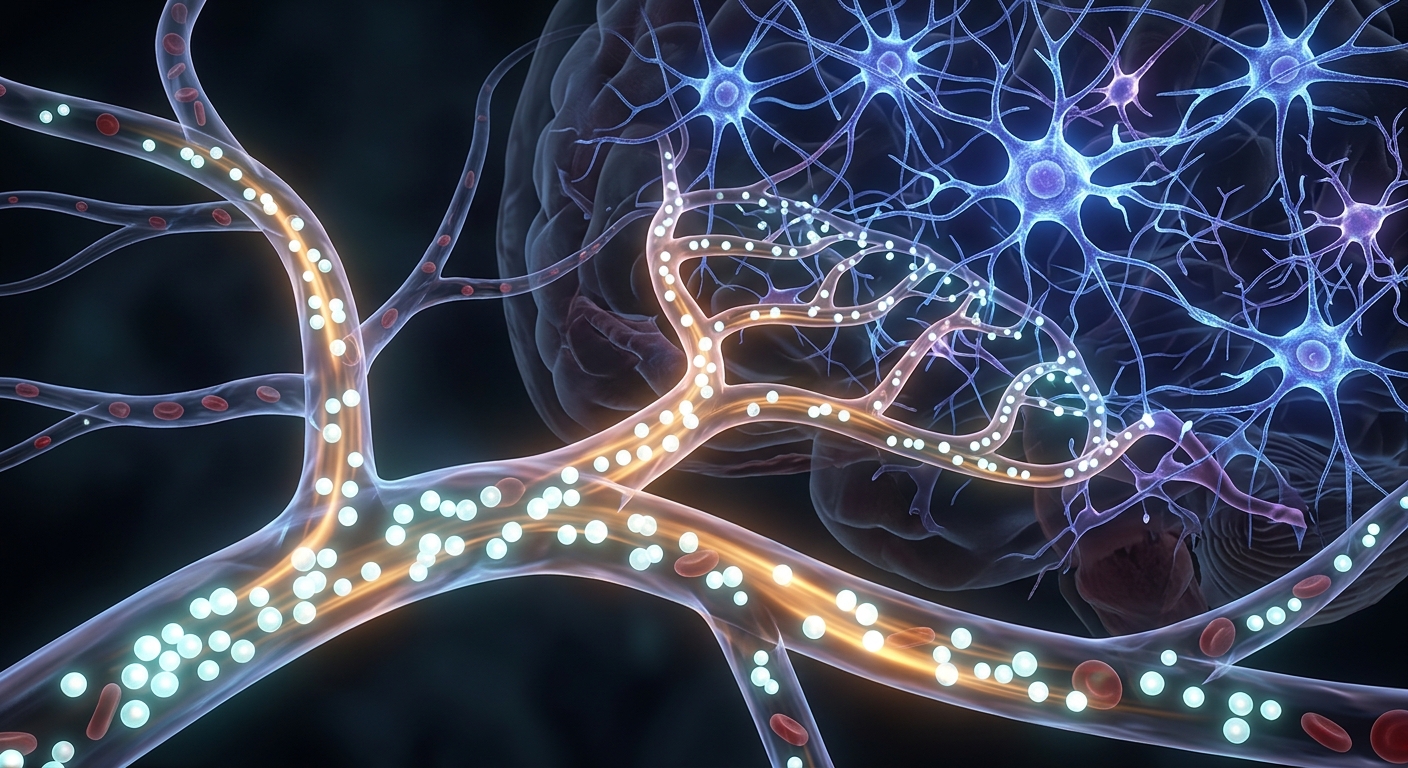
How an anesthetic became a rapid-acting psychiatric intervention
A receptor-to-network account of glutamate signaling, neuroplasticity, dissociation, whole-body physiology, clinical evidence, and the boundaries between off-label ketamine, ketamine-assisted psychotherapy, and FDA-approved esketamine.
Educational article draft. It does not replace diagnosis, emergency evaluation, individualized medical advice, or product labeling.
Abstract
Ketamine presents a physiological paradox: a brief exposure to a dissociative anesthetic can be followed by improvement in depressive symptoms after plasma levels and obvious psychoactive effects have declined. This article follows ketamine from molecule to receptor, synapse, circuit, and clinical service. It separates established pharmacology from proposed downstream models involving AMPA signaling, BDNF-TrkB, mTORC1, protein translation, dendritic spines, metabolites, inflammation, and network reconfiguration. It also distinguishes off-label racemic ketamine, heterogeneous ketamine-assisted psychotherapy, and FDA-approved intranasal esketamine. No single mechanism explains every response, and clinical meaning depends on formulation, route, dose, setting, indication, and evidence base.
The Ketamine Paradox
How can a drug originally designed to produce anesthesia alter depressive symptoms after its obvious psychoactive effects have disappeared? That question is more useful than simply saying that ketamine “blocks NMDA receptors.” The statement is true, but it captures only the first step in a much larger physiological event. Receptors sit on particular cells, those cells participate in local circuits, and local circuits communicate across larger brain networks. At every level, the response can be influenced by dose, route, timing, medications, prior stress, and the state of the brain when the drug is given. Understanding ketamine therefore requires following the consequences of receptor blockade outward, from the molecular level to the behavior of larger neural systems.
Ketamine changed psychiatric research in part because it challenged a longstanding assumption about speed. Conventional antidepressants can be effective, but symptom improvement commonly develops gradually. In early controlled ketamine studies, researchers observed meaningful group-level changes within hours or days (Berman et al.; Zarate et al.). “Rapid,” however, does not mean universal, permanent, or free of expectancy effects. Some patients do not respond, while others improve only temporarily. Ketamine’s importance was that it demonstrated that clinically meaningful changes in depressive symptoms could occur much faster than older antidepressant models had predicted. That finding shifted the scientific question from simply asking what ketamine binds to toward asking what happens after that first molecular interaction, and which of those downstream changes actually matter for recovery.
1. What Is Ketamine?
Ketamine is a chiral molecule, meaning it exists in two three-dimensional forms that are mirror images of one another but cannot be perfectly superimposed. These forms, called enantiomers, are R-ketamine, or arketamine, and S-ketamine, or esketamine. Racemic ketamine contains approximately equal amounts of both. Esketamine is therefore not simply another name for ketamine; it is the S-enantiomer prepared as a distinct drug product. S-ketamine binds to NMDA receptors with greater potency than R-ketamine, but stronger NMDA-receptor antagonism does not automatically mean greater antidepressant effectiveness. Route of administration, drug exposure, metabolism, study design, and treatment setting may all influence the final clinical effect (Zanos et al., “Ketamine and Ketamine Metabolite Pharmacology”).
These distinctions matter when interpreting research. Evidence from an intravenous racemic-ketamine trial cannot automatically be transferred to intranasal esketamine, oral compounded ketamine, intramuscular ketamine, or R-ketamine. The treatments are closely related, but they are not identical biological or clinical exposures. This is especially important because the word “ketamine” is often used loosely in public discussion even when the formulation, route, dose pattern, and regulatory status differ substantially.
Ketamine was originally developed as a dissociative anesthetic, a term describing an unusual state that can combine profound pain relief with altered awareness in a pattern different from classic general anesthesia (Domino et al.). At lower or differently timed exposures, ketamine can produce analgesia, sedation, perceptual changes, impaired coordination, or dissociation without producing surgical anesthesia. These effects can overlap, but they are not interchangeable. The word “subanesthetic” simply means that the exposure is below that typically used to produce anesthesia; it does not mean that the drug is physiologically inactive or automatically safe.
2. What Happens after Ketamine Enters the Body
How ketamine enters the body changes what happens next. Intravenous administration places the drug directly into the circulation and allows clinicians to control the rate of delivery, while intramuscular, intranasal, oral, and sublingual administration first require absorption across tissue or mucosal surfaces. These routes can produce different peak concentrations, timing, bioavailability, and metabolite profiles. That is why the same number of milligrams delivered by two different routes should not be assumed to produce the same biological exposure. Route is not merely a convenience or delivery preference; it is part of the pharmacology.
Ketamine reaches the brain rapidly because it readily crosses the blood-brain barrier. The liver then converts it into norketamine and several additional metabolites, including hydroxynorketamines. Enzyme activity, liver function, route, other medications, and individual biological differences can all influence this process. Some of the resulting metabolites are pharmacologically active, which has led researchers to ask whether ketamine’s antidepressant effects come entirely from the parent drug or partly from compounds formed during metabolism. Human exposure to these metabolites is well established, but their exact contribution to clinical antidepressant response remains uncertain (Zanos et al., “Ketamine and Ketamine Metabolite Pharmacology”).
Ketamine also provides a useful example of the difference between pharmacokinetics and pharmacodynamics. Pharmacokinetics describes what the body does to a drug through absorption, distribution, metabolism, and elimination, while pharmacodynamics describes what the drug does to the body through changes in receptor activity, cell signaling, perception, autonomic function, and behavior. With ketamine, those processes do not necessarily end together. Blood concentrations and obvious dissociation can decline while downstream biological effects continue to unfold. This temporal separation is central to understanding why ketamine’s psychiatric effects cannot be explained by drug concentration alone.
3. NMDA Receptors: The Starting Point, Not the Whole Explanation
Glutamate is the major excitatory neurotransmitter in the mammalian brain, and two of the most important receptors that respond to it are NMDA and AMPA receptors. AMPA receptors carry much of the brain’s rapid excitatory signaling, while NMDA receptors operate differently because their activity depends on both glutamate binding and the electrical state of the receiving neuron. This makes NMDA receptors especially important in activity-dependent changes at synapses. Ketamine acts as a noncompetitive, use-dependent blocker inside the open NMDA-receptor channel. That receptor-level action is well established, but the physiological consequences are much more complicated than the phrase “NMDA blocker” suggests.
One of the most interesting puzzles in ketamine research is that blocking an excitatory receptor can, under some conditions, temporarily increase measures of glutamatergic signaling. One influential explanation involves a process called disinhibition. Some GABA-producing interneurons normally place inhibitory “brakes” on nearby excitatory pyramidal neurons. If ketamine reduces NMDA-dependent signaling in those inhibitory interneurons, some of that restraint may be released. The pyramidal neurons can then increase their output, potentially increasing downstream signaling through AMPA receptors. In simplified terms, ketamine may reduce one form of inhibition in a way that allows another component of excitatory signaling to temporarily increase.
This model is useful, but it should not be treated as a universal circuit diagram. NMDA receptors are found on inhibitory and excitatory neurons, at synaptic and extrasynaptic locations, and across brain regions with very different functions. Other experiments emphasize direct effects on pyramidal neurons, spontaneous NMDA signaling, or region-specific patterns of neuronal firing. Ketamine’s effects therefore depend not only on which receptor is blocked but also on where that receptor is located, which cell expresses it, and what the surrounding neural circuit is doing at the time.
4. From Receptor Blockade to Neuroplasticity
The story does not end when ketamine blocks an NMDA receptor. Across many preclinical models, AMPA-receptor activity appears to be important for ketamine-like antidepressant effects, which has shifted attention toward the balance between NMDA and AMPA signaling after ketamine administration. One proposed downstream pathway involves brain-derived neurotrophic factor, or BDNF. BDNF is a signaling protein involved in the brain’s ability to modify and maintain neural connections. When BDNF activates its receptor, TrkB, it can support several processes involved in synaptic plasticity. In mice, one proposed mechanism begins when ketamine blocks spontaneous NMDA-receptor signaling, reduces activity of eEF2 kinase, and promotes rapid production of BDNF protein (Autry et al.).
Another major line of research involves mTORC1, a signaling system that helps regulate protein production and cellular growth. In rodent prefrontal cortex, ketamine rapidly activated mTOR-related signaling, increased several proteins involved in synaptic function, and promoted formation of new spine synapses. Blocking mTOR signaling interfered with those effects (Li et al.). Dendritic spines are tiny structures on neurons where many excitatory synapses form; in practical terms, they are some of the physical sites where neurons communicate. Chronic stress can reduce spine number and function in selected animal brain circuits, so researchers began investigating whether restoring some of these connections could contribute to ketamine’s longer-lasting effects.
The timing of those changes is especially important. In a mouse stress model, behavioral improvement appeared before new dendritic spines formed, while the newly formed spines appeared to help sustain circuit recovery later (Moda-Sava et al.). That finding argues against the simplified claim that ketamine works because it immediately “grows new synapses.” A more cautious interpretation is that rapid molecular and circuit-level effects may begin the response, while structural plasticity helps stabilize some of those changes afterward.
Ketamine’s metabolites add another layer to the story. A landmark mouse study proposed that the metabolite (2R,6R)-hydroxynorketamine contributed to antidepressant-like effects without requiring conventional NMDA-receptor inhibition (Zanos et al., “NMDAR Inhibition-Independent”). Later studies have supported, modified, and challenged parts of that hypothesis. Researchers have also investigated opioid signaling, monoamines, inflammatory pathways, glycogen synthase kinase-3, circadian biology, and homeostatic synaptic mechanisms. The emerging picture is not one pathway replacing all the others. Ketamine appears to affect several interacting biological systems, and the mechanisms that matter most may differ according to brain region, timing, and individual patient.
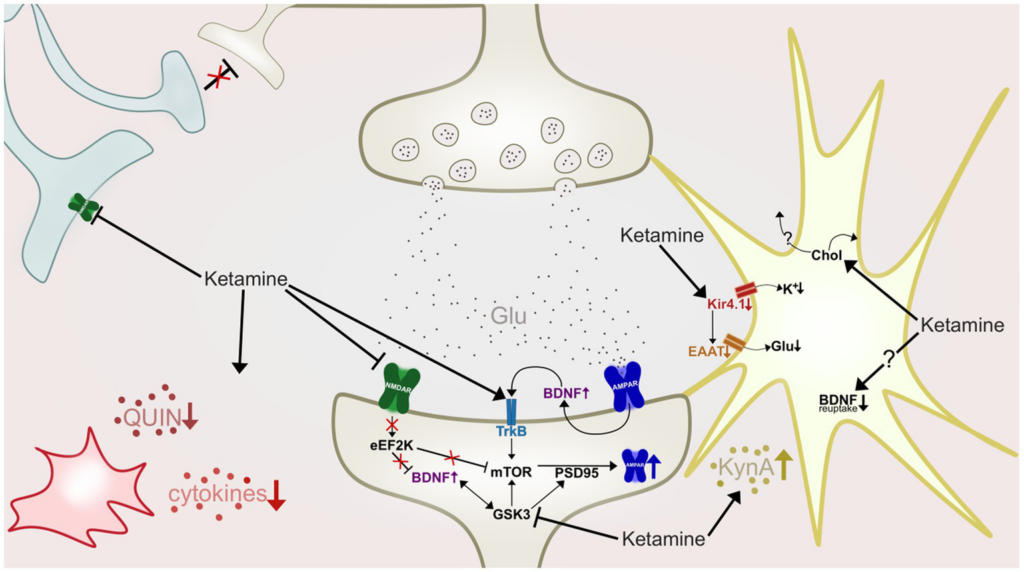
Figure 1. Proposed ketamine mechanisms at neuronal and glial levels. Reproduced from Lullau et al. (2023), fig. 3, under CC BY 4.0. A peer-reviewed schematic shows proposed actions on GABAergic interneurons, pyramidal neurons, NMDA and AMPA receptors, BDNF-TrkB, mTOR, eEF2K, GSK-3, astrocytes, microglia, cytokines, quinolinic acid, and kynurenic acid. The source labels these mechanisms as hypothesized rather than universally established.
5. Why Can the Effect Outlast the Drug?
A biological effect does not always disappear when its original trigger disappears. Learning, stress, inflammation, seizures, and brain stimulation can all influence the behavior of neural circuits after the initiating event has ended. Ketamine may do something similar by temporarily changing how responsive certain synapses and circuits are to later activity. This period is sometimes described as a “plasticity window,” although researchers have not established one precise duration or biological definition that applies to every patient. The idea is useful because it helps explain how a brief pharmacological event could be followed by longer-lasting biological and behavioral effects.
Neuroplasticity, however, should not be confused with recovery. Plasticity simply means that the nervous system has an increased capacity to change, and that change is not automatically beneficial. During a period of altered plasticity, sleep, stress, relationships, behavior, psychotherapy, and continued medical treatment may all influence which patterns are reinforced. This provides a biological rationale for studying behavioral or psychotherapeutic interventions around ketamine treatment, but it does not prove that a particular type of “integration” is required or that psychotherapy automatically makes ketamine more effective. Plasticity creates the possibility of change, not a guarantee about the direction that change will take.
This distinction also helps explain why rapid response and durable response are separate clinical problems. Some patients do not respond to ketamine at all, some improve and later relapse, and others maintain improvement with additional treatment or a broader maintenance strategy. Ketamine can therefore be thought of as operating on two clocks. On one clock, the drug enters the body, produces acute physiological and perceptual effects, and is metabolized. On the second, downstream signaling, circuit adaptation, symptoms, and the possibility of relapse unfold over a longer period. Understanding how those two timelines interact may be one of the central challenges in ketamine research.
6. From Synapses to Brain Circuits
Depression does not reside in one receptor, one neuron, or one “depression center.” Research instead points toward altered communication among systems involved in cognitive control, emotional learning, memory, reward, self-referential thought, and attention. These include prefrontal and cingulate regions, the hippocampus and amygdala, reward-related striatal systems, and larger default-mode, salience, and executive-control networks. Ketamine can alter activity or connectivity within parts of these systems, but human neuroimaging studies are generally small, methodologically diverse, and often correlational. Brain scans can therefore show that something changed without proving exactly why a patient’s symptoms improved.
One particularly interesting clue comes from the lateral habenula, a small brain region involved in signaling negative outcomes and regulating reward-related systems. In rodent models displaying depression-like behavior, researchers identified abnormal burst firing in this region. Ketamine reduced that bursting, and blocking NMDA-dependent burst activity produced rapid behavioral effects (Yang et al.). The study illustrates an important principle: because ketamine blocks open NMDA channels, its effect may depend partly on how active a particular circuit already is. A receptor repeatedly recruited during abnormal burst firing may respond differently from the same receptor in a relatively quiet network. The lateral-habenula findings are therefore a compelling example of state- and region-dependent action, but they do not establish lateral-habenula bursting as the cause of every human depressive episode.
Functional MRI offers another way to examine ketamine at the network level. Resting-state fMRI looks for statistical relationships in slow blood-oxygen-level signals while a person is not performing a specific task, while task-based fMRI measures activity during cognitive or emotional challenges. Studies have reported changes after ketamine in frontostriatal, limbic, default-mode, and salience-related connectivity, and some of those changes correlate with symptom improvement. However, fMRI cannot show an NMDA receptor opening or closing, directly demonstrate that a new synapse has formed, or prove that a connectivity change caused recovery. Brain-network findings are therefore best understood as systems-level clues rather than photographs of the mechanism.
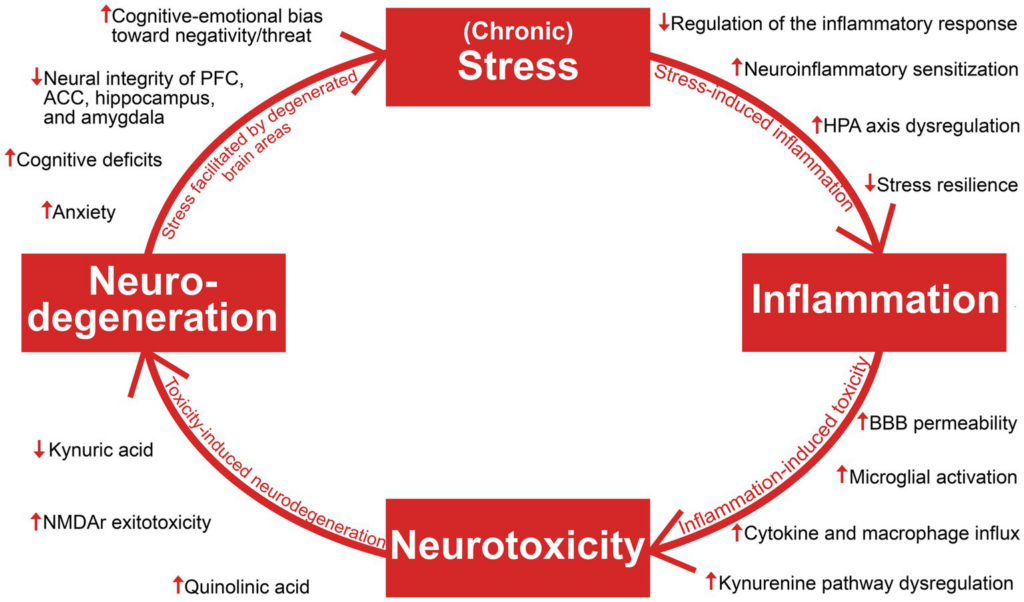
Figure 2. Neuroprogressive factors associated with depression. Reproduced from Lullau et al. (2023), fig. 1, under CC BY 4.0. A peer-reviewed circular model links chronic stress, inflammation, neurotoxicity, and neurodegeneration. Labels identify proposed reinforcing processes involving the HPA axis, blood-brain barrier, cytokines, kynurenine metabolites, glutamatergic excitotoxicity, cognitive-emotional bias, and neural integrity.
7. The Physiology of Dissociation
Dissociation is one of ketamine’s most recognizable acute effects and can include changes in body ownership, time, space, perception, or the sense of distance between a person and their thoughts or emotions. Normally integrated sensory and self-referential processes can temporarily feel separated. Physiologically, ketamine may alter coordination among cortical, thalamic, hippocampal, and sensory systems while also changing patterns of neural oscillation and predictive processing. The subjective experience varies considerably. For some people it may feel neutral or meaningful, while for others it can be disorienting, unpleasant, or frightening.
Whether dissociation is actually necessary for ketamine’s antidepressant effect remains uncertain. Some studies have reported relationships between stronger acute dissociation and greater later improvement, but those correlations account for only part of the variation in response and are difficult to separate from expectancy and functional unblinding. Ketamine’s psychoactive effects often make it easier for participants to guess whether they received the active drug, which can influence both expectations and symptom reporting. Other studies have found antidepressant improvement without a strong relationship between dissociation and outcome. A systematic review concluded that the evidence is too heterogeneous to treat dissociation as a validated therapeutic biomarker (Bahji et al.).
Ketamine also should not simply be grouped with classic serotonergic psychedelics. Psilocybin and LSD act primarily through serotonin 5-HT2A receptors, whereas ketamine’s defining pharmacology is NMDA-channel antagonism. Both can alter perception, and both may be used within psychotherapeutic settings, but their core pharmacology is fundamentally different. Similarity in subjective experience does not mean that the drugs act through the same biological pathway.
Figure 3. Proposed sites at which ketamine may interrupt a neuroprogressive cycle in depression. Reproduced from Lullau et al. (2023), fig. 2, under CC BY 4.0. A peer-reviewed circular model proposes that ketamine may affect chronic stress, inflammation, neurotoxicity, and neurodegeneration through changes in stress resilience, prefrontal regulation, inflammatory signaling, glutamate-related toxicity, kynurenine metabolites, astrocyte density, and synaptogenesis. These are proposed mechanisms, not proof of one causal pathway in every patient.
8. Ketamine beyond the Brain
Ketamine commonly increases sympathetic nervous-system activity during acute administration, which can raise blood pressure and heart rate. The size and clinical importance of these changes vary among patients, but they are especially relevant for people with cardiovascular or cerebrovascular risk. Ketamine is also known for preserving breathing better than many traditional anesthetic agents, yet the claim that it cannot suppress respiration is incorrect. Rapid intravenous administration, higher exposure, airway complications, and combinations with other central nervous system depressants can contribute to respiratory depression, apnea, laryngospasm, or airway obstruction (U.S. Food and Drug Administration, Ketamine Hydrochloride Injection). These effects help explain why monitoring remains important even when ketamine is being used below anesthetic doses.
Other acute effects can include dizziness, blurred vision, impaired coordination, sedation, anxiety, nausea, and vomiting. These symptoms are among the reasons patients should not drive until allowed by the applicable treatment protocol or product labeling. Longer-term safety raises different questions. Repeated heavy nonmedical ketamine use is clearly associated with ulcerative cystitis and other urinary tract injury. Such complications appear to be much less common at psychiatric treatment exposures, but lower risk is not zero risk, particularly as cumulative exposure increases. Repeated or continuous medically supervised use has also been associated in case reports and pharmacovigilance data with elevated liver enzymes and biliary abnormalities (Cotter et al.).
These observations should be interpreted carefully. They do not mean that a short psychiatric course commonly causes bladder or liver injury. They do show why the safety of prolonged repeated exposure should not simply be assumed from ketamine’s long history as an anesthetic. One-time anesthesia and months or years of intermittent psychiatric treatment are different exposure patterns and may raise different safety questions. Long-term surveillance becomes increasingly important as treatment duration and cumulative exposure increase.
Ketamine and esketamine are also Schedule III controlled substances in the United States. Medical treatment is not the same as a substance-use disorder, but ketamine’s reinforcing and dissociative effects mean that clinicians must consider misuse, escalating exposure, secure handling, and patient selection. FDA warnings about compounded ketamine products have emphasized risks including sedation, dissociation, blood-pressure changes, respiratory depression, misuse, and the absence of standardized post-dose monitoring in unsupervised settings (U.S. Food and Drug Administration, “FDA Warns”). These risks are part of the reason psychiatric ketamine treatment is best understood within a structured clinical system rather than as a simple prescription.
9. From Operating Room to Psychiatry
Ketamine’s psychiatric story began in the operating room. Early human experiments in the 1960s characterized CI-581, later named ketamine, as a rapidly acting dissociative anesthetic (Domino et al.), and the United States approved ketamine injection as a general anesthetic in 1970. Decades of use in anesthesia and pain medicine produced substantial clinical experience with its acute physiological effects. That history, however, did not answer a different question: what happens when smaller or repeated exposures are used to treat psychiatric illness rather than to produce anesthesia?
That question became much more important in 2000, when Berman and colleagues reported rapid reductions in depressive symptoms after a single intravenous ketamine infusion. In 2006, Zarate and colleagues replicated the signal in treatment-resistant depression. The findings attracted attention not only because symptoms improved, but because the timing was unusual. Instead of waiting weeks to determine whether treatment was working, researchers were observing measurable group-level differences within hours or days. Later trials tested active comparators such as midazolam, repeated infusion schedules, and maintenance approaches (Murrough et al.; Phillips et al.).
A separate development program eventually produced intranasal esketamine. FDA approved esketamine for adult treatment-resistant depression in 2019 and later expanded its approved uses, including a 2025 expansion allowing monotherapy for treatment-resistant depression (U.S. Food and Drug Administration, SPRAVATO). This marked an important regulatory step in the psychiatric history of ketamine-related treatments while preserving a clear distinction between a product specifically reviewed for psychiatric use and racemic ketamine prescribed off-label.
10. Three Interventions That Must Remain Distinct
| Intervention | Regulatory status (U.S.) | What it is | What must not be assumed |
| Racemic ketamine | FDA-approved as an injectable general anesthetic; psychiatric use is off-label. | A 50:50 mixture of R- and S-ketamine, commonly studied intravenously for depression. | Off-label does not mean FDA-approved, standardized across clinics, or equivalent to esketamine. |
| Esketamine nasal spray | FDA-approved under specific adult depression indications and a REMS. | The S-enantiomer delivered with a proprietary nasal device in a certified healthcare setting. | It is not simply a take-home version of ketamine, and its label does not apply to compounded nasal ketamine. |
| Ketamine-assisted psychotherapy (KAP) | No FDA-approved psychotherapy protocol or indication as a combined product. | A heterogeneous family of models pairing ketamine exposure with structured psychological preparation, support, and/or integration. | Evidence for ketamine alone cannot be treated as proof that a particular psychotherapy pairing adds benefit. |
Table 1. Regulatory and evidentiary distinctions among racemic ketamine, esketamine nasal spray, and ketamine-assisted psychotherapy.
The phrase “ketamine treatment” is often used as though it describes one standardized intervention, but it does not. Three approaches in particular need to remain separate: off-label racemic ketamine, FDA-approved intranasal esketamine, and ketamine-assisted psychotherapy. Racemic ketamine injection is FDA-approved as a general anesthetic, not as an antidepressant. Clinicians can prescribe approved medications off-label when medically appropriate, and intravenous racemic ketamine has the strongest experimental tradition in psychiatric research. Intramuscular, oral, sublingual, and compounded intranasal approaches are also used in practice, but the strength and consistency of evidence vary by route.
SPRAVATO, by contrast, is a proprietary intranasal esketamine product administered under direct supervision in a certified healthcare setting. Patients are observed after administration, and the product is not dispensed directly for unsupervised home use. Its current label includes adult treatment-resistant depression as monotherapy or together with an oral antidepressant. It also includes depressive symptoms in adults with major depressive disorder and acute suicidal ideation or behavior when used with an oral antidepressant (U.S. Food and Drug Administration, SPRAVATO). The label contains important limitations for that acute-suicidality indication, discussed in the clinical-evidence section below.
Ketamine-assisted psychotherapy, or KAP, is different again because it is not one standardized treatment model. Programs vary in route, dose, preparation, therapist training, timing of psychotherapy, and what they mean by “integration.” In some settings, psychological support is primarily intended to maintain comfort and safety during acute effects. In others, psychotherapy is treated as a central part of the intervention. A positive pharmacological study of ketamine does not determine whether adding a particular psychotherapy improves outcomes, and a positive KAP case series cannot separate the effects of the drug from psychotherapy, expectancy, setting, and patient selection. A 2026 systematic review found encouraging results but only eleven eligible studies and substantial methodological variation (Simpson and Juruena), indicating that larger controlled studies are still needed.
11. What the Clinical Evidence Shows
The most reproducible clinical finding is also the reason ketamine became so influential: subanesthetic intravenous racemic ketamine can rapidly reduce depressive symptom ratings in some people with major depression. The earliest placebo-controlled studies were small (Berman et al.; Zarate et al.), but later research strengthened the signal. A larger two-site study using midazolam as an active control found antidepressant benefit while also illustrating a persistent methodological problem: a drug with recognizable psychoactive effects is difficult to blind completely (Murrough et al.). Repeated infusions can produce additional benefit in some patients, and selected responders may maintain improvement with spaced treatments, but the best long-term frequency, duration, and stopping strategy remain uncertain (Phillips et al.).
The ELEKT-D trial provided an important comparison with another interventional psychiatric treatment. Among adults with nonpsychotic treatment-resistant major depression referred for ECT, intravenous ketamine was noninferior to ECT for response during the acute treatment phase (Anand et al.). That finding is clinically meaningful, but it must be interpreted within the population studied. The trial was open-label and excluded psychotic depression, so it does not establish ketamine as a replacement for ECT across all severe depressive presentations. ECT and ketamine remain distinct treatments with different evidence bases, risks, and clinical roles.
Intranasal esketamine has its own product-specific evidence base. In TRANSFORM-2, esketamine plus a newly initiated oral antidepressant produced a greater average reduction in depressive symptoms than placebo nasal spray plus an oral antidepressant, while dissociation, nausea, vertigo, altered taste, and dizziness were more common with esketamine (Popova et al.). In SUSTAIN-1, patients who had responded or remitted and continued esketamine plus an oral antidepressant had a lower risk of relapse than patients switched to placebo nasal spray while continuing the oral antidepressant (Daly et al.). A later placebo-controlled trial also demonstrated efficacy for esketamine monotherapy in adults with treatment-resistant depression, supporting the 2025 label expansion (Janik et al.). These findings apply to the studied product, schedules, settings, and populations and should not automatically be generalized to compounded intranasal products.
The evidence involving acute suicidal ideation requires especially careful language. In the ASPIRE studies, hospitalized adults with major depressive disorder and acute suicidal ideation with intent received comprehensive standard care and an oral antidepressant along with either esketamine or placebo nasal spray. Esketamine produced a more rapid improvement in depressive symptom scores, but the studies did not establish a direct suicide-prevention effect independent of the intensive care patients were already receiving (Fu et al.). This distinction is reflected in the product labeling, which states that effectiveness in preventing suicide or reducing suicidal ideation or behavior has not been demonstrated. Improvement in depressive symptoms also does not remove the need for hospitalization or emergency care when clinically warranted. Rapid improvement in depressive symptoms is not the same as demonstrating that a treatment prevents suicide.
Several broader limitations remain. Ketamine’s distinctive psychoactive effects can reveal treatment assignment and increase expectancy, meaning even active controls cannot completely solve the blinding problem. A rapid response after one administration does not necessarily translate into durable remission, and findings from one patient population should not automatically be applied to bipolar depression, psychotic depression, substance-use disorders, medically complex patients, adolescents, or older adults. Racemic ketamine and esketamine have also rarely been compared under equivalent routes, exposures, and protocols. The strongest conclusion is therefore narrower: rapid antidepressant effects are reproducible with monitored intravenous racemic ketamine and FDA-approved intranasal esketamine in selected adult depressive populations.
12. Why Ketamine Is an Interventional Treatment
Ketamine is more than a medication given to a patient with instructions to take it at home. Within interventional psychiatry, treatment is a procedure-like episode embedded within a larger clinical system. Before administration, clinicians may need to confirm the diagnosis and prior treatment history, review medications, assess relevant medical and psychiatric risks, establish the treatment goal, and explain the evidence and uncertainties surrounding the particular product and route being used. These steps matter because individual medical or psychiatric vulnerabilities can alter both risk and treatment planning.
During treatment, monitoring may include blood pressure, heart rate, breathing, alertness, psychological distress, and recovery from acute effects. The clinical setting must be prepared to respond if significant cardiovascular, respiratory, behavioral, or psychological complications occur. After treatment, the question is not simply whether the patient experienced dissociation or an intense subjective state. The more important question is whether depressive symptoms and everyday functioning improve over time. That is why longitudinal follow-up and measurement-based care are essential.
A maintenance plan should define what counts as a meaningful response, when treatment should continue or stop, how adverse effects will be monitored, and how ketamine fits alongside medication management, psychotherapy, sleep, substance-use treatment, social support, and emergency planning. FDA-approved esketamine also adds product-specific requirements through its label and REMS. This combination of screening, monitored administration, recovery, and longitudinal assessment is one reason ketamine fits within interventional psychiatry rather than being understood simply as another antidepressant prescription.
13. What Scientists Still Don’t Know
Ketamine has answered one major question: rapid antidepressant change is biologically possible. It has also created many new ones. Researchers still do not know which molecular and circuit changes are truly necessary for antidepressant response in humans and which occur alongside improvement without causing it. They do not yet have reliable biomarkers that can predict who will respond, who will relapse, who will experience severe dissociation, or who may be more vulnerable to cumulative toxicity. Even some of the best-known mechanistic pathways, including AMPA signaling, BDNF-TrkB, mTORC1, dendritic-spine remodeling, and metabolite activity, remain easier to demonstrate experimentally than to connect directly to clinical recovery in an individual patient.
The proposed plasticity window raises another important question. If ketamine temporarily makes certain neural systems more capable of change, how long does that period last, and can psychotherapy or behavioral learning reliably take advantage of it? Long-term treatment creates additional uncertainty about the safest and least burdensome maintenance strategies over years rather than months, including appropriate surveillance of bladder function, liver function, cognition, blood pressure, misuse, and dependence. The field also needs better evidence for how racemic ketamine, esketamine, ECT, TMS, conventional medications, and psychotherapy should be sequenced for different forms of treatment-resistant depression.
Ketamine-assisted psychotherapy requires its own rigorous testing. Studies need to define the psychotherapy being used, compare it with credible control conditions, measure expectancy and therapist effects, and separate improvement during acute intoxication from durable clinical change. Answering these questions will require larger controlled trials, clearer definitions of treatment components, longer follow-up, and better ways to connect biological changes with outcomes that patients actually experience.
Conclusion: A Perturbation with Consequences
Ketamine’s importance is not that it solved depression or revealed one master biological pathway. Its importance is that a relatively brief change in glutamate signaling can be followed by rapid clinical improvement in some patients. That observation forced psychiatry to connect receptor pharmacology with synaptic adaptation, brain circuits, subjective experience, and the structure of clinical treatment. Some parts of this story are well established: ketamine and esketamine block NMDA-receptor channels, intravenous racemic ketamine can rapidly reduce depressive symptoms in controlled studies, intranasal esketamine has specific FDA-approved psychiatric indications, and acute exposure can affect perception, blood pressure, alertness, coordination, and other physiological systems.
Other parts remain less certain. AMPA signaling, BDNF-TrkB, mTORC1, dendritic-spine remodeling, and changes in network activity are supported by substantial experimental evidence, but the exact chain connecting those biological effects to human recovery has not been fully established. Still other questions remain open, including whether dissociation is therapeutically important, whether particular ketamine metabolites are essential, and whether specific forms of psychotherapy add benefit beyond the drug itself. That uncertainty does not diminish ketamine’s importance; it defines the next stage of research.
Careful language is therefore essential. Off-label racemic ketamine is not FDA-approved esketamine, and ketamine-assisted psychotherapy is not the same intervention as pharmacological ketamine treatment. A drug that often preserves breathing is also not a drug that requires no monitoring. Preserving those distinctions makes the science more accurate while helping clinicians and patients understand both what ketamine can do and what remains uncertain.
Ketamine’s most important contribution may ultimately be larger than the treatment itself. It demonstrated that psychiatric symptoms can sometimes change on a remarkably short biological timescale and challenged researchers to explain how a brief pharmacological event can produce consequences that outlast the drug’s most obvious effects.
Works Cited
Anand, Amit, et al. “Ketamine versus ECT for Nonpsychotic Treatment-Resistant Major Depression.” New England Journal of Medicine, vol. 388, no. 25, 2023, pp. 2315–2325. https://doi.org/10.1056/NEJMoa2302399.
Autry, Anita E., et al. “NMDA Receptor Blockade at Rest Triggers Rapid Behavioural Antidepressant Responses.” Nature, vol. 475, 2011, pp. 91–95. https://doi.org/10.1038/nature10130.
Bahji, Anees, et al. “The Relationship between Subjective Effects Induced by a Single Dose of Ketamine and Treatment Response in Patients with Major Depressive Disorder: A Systematic Review.” Journal of Affective Disorders, vol. 264, 2020, pp. 123–129. https://doi.org/10.1016/j.jad.2019.12.023.
Berman, Robert M., et al. “Antidepressant Effects of Ketamine in Depressed Patients.” Biological Psychiatry, vol. 47, no. 4, 2000, pp. 351–354. https://doi.org/10.1016/S0006-3223(99)00230-9.
Cotter, Samantha, et al. “Repeated or Continuous Medically Supervised Ketamine Administration Associated with Hepatobiliary Adverse Events: A Retrospective Case Series.” Drug Safety, vol. 44, 2021, pp. 1365–1374. https://doi.org/10.1007/s40264-021-01120-9.
Daly, Ella J., et al. “Efficacy of Esketamine Nasal Spray plus Oral Antidepressant Treatment for Relapse Prevention in Patients with Treatment-Resistant Depression: A Randomized Clinical Trial.” JAMA Psychiatry, vol. 76, no. 9, 2019, pp. 893–903. https://doi.org/10.1001/jamapsychiatry.2019.1189.
Domino, Edward F., Peter Chodoff, and Guenter Corssen. “Pharmacologic Effects of CI-581, a New Dissociative Anesthetic, in Man.” Clinical Pharmacology & Therapeutics, vol. 6, no. 3, 1965, pp. 279–291. https://doi.org/10.1002/cpt196563279.
Fu, Dong-Jing, et al. “Esketamine Nasal Spray for Rapid Reduction of Major Depressive Disorder Symptoms in Patients Who Have Active Suicidal Ideation with Intent: Double-Blind, Randomized Study (ASPIRE I).” Journal of Clinical Psychiatry, vol. 81, no. 3, 2020, article 19m13191. https://pubmed.ncbi.nlm.nih.gov/32412700/.
Janik, Adam, et al. “Esketamine Monotherapy in Adults with Treatment-Resistant Depression: A Randomized Clinical Trial.” JAMA Psychiatry, vol. 82, no. 9, 2025, pp. 877–887. https://doi.org/10.1001/jamapsychiatry.2025.1317.
Li, Nanxin, et al. “mTOR-Dependent Synapse Formation Underlies the Rapid Antidepressant Effects of NMDA Antagonists.” Science, vol. 329, no. 5994, 2010, pp. 959–964. https://doi.org/10.1126/science.1190287.
Lullau, August P. M., et al. “Antidepressant Mechanisms of Ketamine: A Review of Actions with Relevance to Treatment-Resistance and Neuroprogression.” Frontiers in Neuroscience, vol. 17, 2023, article 1223145. https://doi.org/10.3389/fnins.2023.1223145.
Moda-Sava, Rachel N., et al. “Sustained Rescue of Prefrontal Circuit Dysfunction by Antidepressant-Induced Spine Formation.” Science, vol. 364, no. 6436, 2019, article eaat8078. https://doi.org/10.1126/science.aat8078.
Murrough, James W., et al. “Antidepressant Efficacy of Ketamine in Treatment-Resistant Major Depression: A Two-Site Randomized Controlled Trial.” American Journal of Psychiatry, vol. 170, no. 10, 2013, pp. 1134–1142. https://pubmed.ncbi.nlm.nih.gov/23982301/.
Phillips, Jennifer L., et al. “Single, Repeated, and Maintenance Ketamine Infusions for Treatment-Resistant Depression: A Randomized Controlled Trial.” American Journal of Psychiatry, vol. 176, no. 5, 2019, pp. 401–409. https://pubmed.ncbi.nlm.nih.gov/30922101/.
Popova, Vanina, et al. “Efficacy and Safety of Flexibly Dosed Esketamine Nasal Spray Combined with a Newly Initiated Oral Antidepressant in Treatment-Resistant Depression.” American Journal of Psychiatry, vol. 176, no. 6, 2019, pp. 428–438. https://pubmed.ncbi.nlm.nih.gov/31109201/.
Simpson, Rebecca J., and Mario F. Juruena. “Effectiveness of Ketamine-Assisted Psychotherapy as a Treatment for Treatment-Resistant Depression: A Systematic Review.” Psychopharmacology, 2026. https://doi.org/10.1007/s00213-026-07003-0.
U.S. Food and Drug Administration. “FDA Warns Patients and Health Care Providers about Potential Risks Associated with Compounded Ketamine Products, Including Oral Formulations, for the Treatment of Psychiatric Disorders.” 10 Oct. 2023. https://www.fda.gov/drugs/human-drug-compounding/fda-warns-patients-and-health-care-providers-about-potential-risks-associated-compounded-ketamine.
U.S. Food and Drug Administration. Ketamine Hydrochloride Injection: Prescribing Information. DailyMed, revised July 2022. https://dailymed.nlm.nih.gov/dailymed/drugInfo.cfm?setid=ea600f8a-857f-4e0e-e053-2995a90a017d.
U.S. Food and Drug Administration. SPRAVATO (Esketamine) Nasal Spray: Prescribing Information. Revised Jan. 2025. https://www.accessdata.fda.gov/drugsatfda_docs/label/2025/211243s016lbl.pdf.
Yang, Yan, et al. “Ketamine Blocks Bursting in the Lateral Habenula to Rapidly Relieve Depression.” Nature, vol. 554, 2018, pp. 317–322. https://doi.org/10.1038/nature25509.
Zanos, Panos, et al. “Ketamine and Ketamine Metabolite Pharmacology: Insights into Therapeutic Mechanisms.” Pharmacological Reviews, vol. 70, no. 3, 2018, pp. 621–660. https://doi.org/10.1124/pr.117.015198.
Zanos, Panos, et al. “NMDAR Inhibition-Independent Antidepressant Actions of Ketamine Metabolites.” Nature, vol. 533, 2016, pp. 481–486. https://doi.org/10.1038/nature17998.
Zarate, Carlos A., Jr., et al. “A Randomized Trial of an N-Methyl-D-Aspartate Antagonist in Treatment-Resistant Major Depression.” Archives of General Psychiatry, vol. 63, no. 8, 2006, pp. 856–864. https://doi.org/10.1001/archpsyc.63.8.856.
